



What to Know About 1 Bedroom Loft Apartment Floor Plans at a Glance
1 bedroom loft apartment floor plans are one of the most searched layout types for renters who want something beyond the ordinary.
Here's a quick look at what defines them:
- Open-concept living area with no full walls separating the main space
- Sleeping loft or mezzanine level reached by stairs or a ladder
- High ceilings — often 10 to 20+ feet — that create a sense of volume
- Flexible square footage ranging from compact ~370 sq ft ADU-style units up to sprawling 1,300+ sq ft converted spaces
- Industrial or modern aesthetics depending on whether the building is a warehouse conversion or new construction
Loft apartments aren't just a style choice — they're a fundamentally different way to use space. Instead of walls carving a unit into separate rooms, lofts use vertical space and open zones to define where you sleep, eat, and relax.
That freedom is exactly what draws people to them. But it also comes with real trade-offs around privacy, noise, and storage that are worth understanding before you sign a lease.
This guide breaks down the most common floor plan types, what makes each one work (or not), and what to look for when choosing the right layout for your life.
Understanding 1 Bedroom Loft Apartment Floor Plans
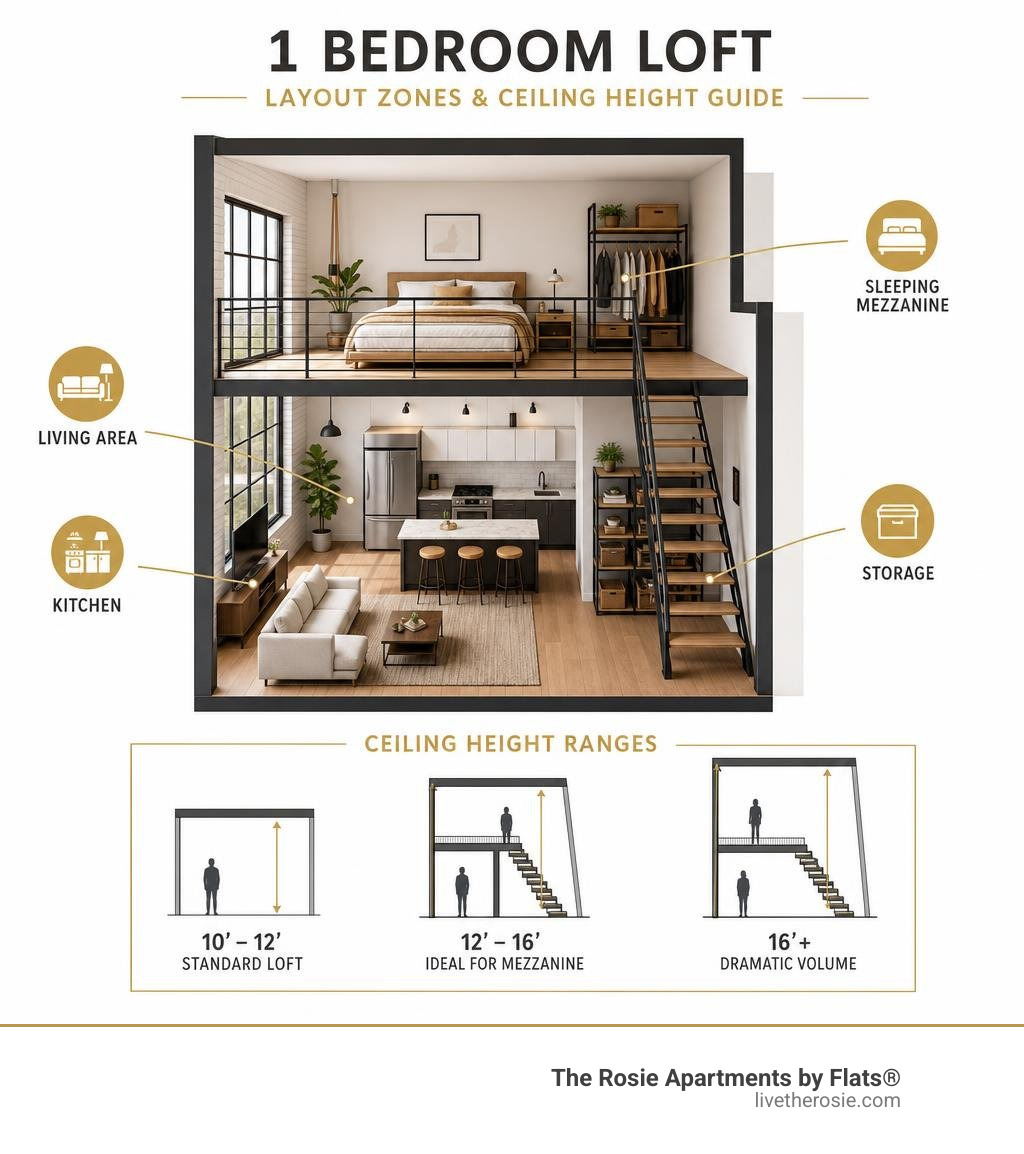
The defining characteristic of any loft apartment is its rejection of traditional walls in favor of open, shared spaces. While a standard one-bedroom apartment relies on drywall partitions to separate the kitchen, living room, and bedroom, a loft floor plan uses structural elements, furniture placement, and vertical levels to establish distinct functional zones.
In a typical 1-bedroom loft, the square footage is distributed to maximize the sense of volume. Ceiling heights play a massive role in this design philosophy. When ceilings reach 12 to 18 feet, a floor plan can easily incorporate a mezzanine level—an elevated platform that overlooks the main living space. This upper level is most commonly designated as the sleeping area, effectively separating the private quarters from the social spaces below without closing them off entirely.
Spatial division in these layouts relies heavily on visual cues. For instance, a kitchen might be defined by a polished concrete island or a transition in flooring materials. The living room is often anchored by a large area rug, while the path to the mezzanine is marked by a structural staircase or a minimalist steel ladder. Renters searching for these unique layouts often look to historic urban neighborhoods where industrial structures have been repurposed into residential spaces, making Pilsen lofts for rent a prime starting point for locating authentic architectural character.
Key Layout Variations in 1-Bedroom Lofts
Not all lofts are created equal. The architectural origin of the building heavily influences the overall floor plan, the materials used, and how the square footage is optimized. Generally, 1-bedroom loft layouts fall into two main categories: historic conversions and modern new construction.
Converted Warehouse 1 Bedroom Loft Apartment Floor Plans
Converted warehouse lofts are the gold standard for authentic industrial style. These apartments are situated in former factories, breweries, or shipping warehouses that have been retrofitted for residential living.
Floor plans in converted warehouses are characterized by their raw, exposed materials. Renters can expect to see original brick walls, heavy timber beams, exposed ductwork, and massive timber or concrete pillars supporting the ceiling. The windows in these units are typically historic, multi-pane steel designs that stretch from floor to ceiling, flooding the open space with natural light.
Because these buildings were not originally designed as residences, the layouts can be wonderfully unconventional. You might find a floor plan with an extra-deep living area, massive structural columns right in the middle of the room, or a elevated platform that serves as a built-in stage for a dining table or office nook. Those interested in exploring these deeply textured, historic layouts can find exceptional examples by browsing the East Pilsen loft apartments guide, which highlights the area's rich industrial heritage.
Modern New Construction 1 Bedroom Loft Apartment Floor Plans
For those who prefer clean lines and predictable layouts, modern new-construction lofts offer a sleek alternative. These buildings are designed from the ground up to mimic the open-concept feel of historic lofts while incorporating contemporary comforts and energy-efficient building standards.
New-construction loft floor plans typically feature polished concrete floors, pristine drywall, and integrated smart home technology. Instead of timber beams, they often showcase minimalist steel accents or smooth poured-concrete ceilings.
The primary advantage of a modern loft layout is spatial optimization. Architects design these units with modern living in mind, ensuring there are dedicated spaces for laundry closets, modern kitchen appliances, and ample built-in storage. Many modern layouts also feature a flexible den or alcove that can easily transition into a home office. To see how contemporary design blends open-concept layouts with high-end finishes, exploring One bedroom apartments in Pilsen reveals how modern floor plans maximize urban living spaces. For renters who decide they need even more separation or a second dedicated bedroom, comparing these layouts to options in a 2 Bedroom Apartments Pilsen Guide can help clarify their spatial needs.
Evaluating Livability: Pros, Cons, and Design Elements
Living in a loft is an incredibly rewarding experience, but it requires a different approach to daily life than a traditional apartment. The very features that make a loft visually stunning—such as soaring ceilings and open spaces—can also present unique functional challenges.
The Role of Vertical Space and Natural Light
The greatest asset of a 1-bedroom loft is its verticality. High ceilings allow for vertical storage solutions, such as floor-to-ceiling shelving units and hanging bike racks, which keep the main floor footprint clear of clutter. Oversized windows ensure that even the deepest parts of the apartment receive daylight, creating a bright, airy atmosphere that boosts mood and productivity.
Privacy and Acoustic Challenges
Because lofts lack traditional floor-to-ceiling walls, sound travels freely. If one person is sleeping on the mezzanine level while another is washing dishes or watching television in the living area below, the acoustic transmission can be disruptive. Privacy is also limited when hosting guests, as the sleeping area is often visible from the main floor.
Heating and Cooling Efficiency
Thermodynamics can be a challenge in loft apartments. Because warm air rises, a mezzanine-level sleeping area can become uncomfortably warm in the summer, while the lower living area remains cool. Conversely, in the winter, heating a space with 15-foot ceilings requires strategic climate control, such as utilizing ceiling fans to push warm air back down to the living level.
Smart Storage Solutions
Without a hallway closet or a traditional bedroom closet, loft renters must get creative. Successful floor plans utilize the space beneath staircases for built-in drawers, use rolling wardrobes as functional room dividers, and select platform beds with integrated storage compartments.
To help weigh these factors, the table below compares the key differences between a traditional 1-bedroom layout and a loft-style floor plan:
| Feature | Traditional 1-Bedroom Apartment | 1-Bedroom Loft Apartment |
|---|---|---|
| Spatial Division | Fixed drywall partitions and doors | Open-concept zones, half-walls, or mezzanines |
| Ceiling Height | Typically 8 to 9 feet | Generally 10 to 18+ feet |
| Acoustic Privacy | High (doors block sound between rooms) | Low (sound travels freely across open spaces) |
| Natural Light | Limited to room-specific windows | Expansive, flowing throughout the entire unit |
| Storage Options | Built-in closets and dedicated pantries | Requires creative vertical and modular storage |
| Layout Flexibility | Low (rooms have fixed functions) | High (zones can be easily rearranged) |
Frequently Asked Questions About 1-Bedroom Lofts
How do loft apartments differ from standard 1-bedroom apartments?
The primary difference lies in the use of walls and doors. A standard 1-bedroom apartment has distinct rooms separated by permanent walls, including a fully enclosed bedroom with a door. A loft apartment features an open-concept layout where the bedroom is either an open alcove on the main floor or an elevated mezzanine level overlooking the living space. This creates a continuous spatial flow and a much greater sense of volume, though it reduces acoustic privacy. Renters looking to browse various styles of these open layouts in the local market often consult regional directories like Loft Apartments For Rent In Chicago | Domu or general listings on Loft Apartments for Rent in Chicago IL.
What is the average square footage of a 1-bedroom loft?
While some micro-loft layouts or accessory dwelling units can be as compact as 370 to 600 square feet, typical urban 1-bedroom lofts range from 700 to over 1,300 square feet. Because of the high ceilings and open sightlines, a loft apartment will almost always feel significantly larger than a traditional apartment with the exact same square footage.
How do you solve privacy and noise issues in a loft layout?
To mitigate sound travel and create private zones without building permanent walls, renters can use several design strategies:
- Install heavy, sound-dampening floor-to-ceiling curtains on ceiling-mounted tracks around the sleeping area.
- Place large, plush area rugs and acoustic wall panels to absorb ambient sound.
- Use tall, double-sided bookshelves as functional room dividers that block sightlines while adding valuable storage.
- Position the bed away from the edge of the mezzanine to naturally shield it from the view of the living area below.
Conclusion
Choosing a 1-bedroom loft floor plan is about embracing a lifestyle of creativity, openness, and architectural character. Whether drawn to the historic charm of timber beams and exposed brick or the clean, energy-efficient lines of modern construction, these layouts offer an inspiring canvas for urban living.
For those seeking the perfect balance of modern luxury and vibrant neighborhood culture, The Rosie Apartments by Flats® offers an exceptional living experience in Chicago's historic Pilsen neighborhood. Featuring premium finishes, a stunning rooftop deck, an outdoor pool, and a pet-friendly policy welcoming up to two pets, these residences bring contemporary comfort to one of the city's most artistic enclaves. Explore the available layouts and find your next home by visiting The Rosie Floor Plans.


